Haopeng Deng

* Equal contribution · † Corresponding author

SpinFlow: A Physics-Informed Spin Field Framework for Traffic Phase Inference and Transition Detection
Haopeng Deng*, Fucheng Zheng*, Xinhai Xia†

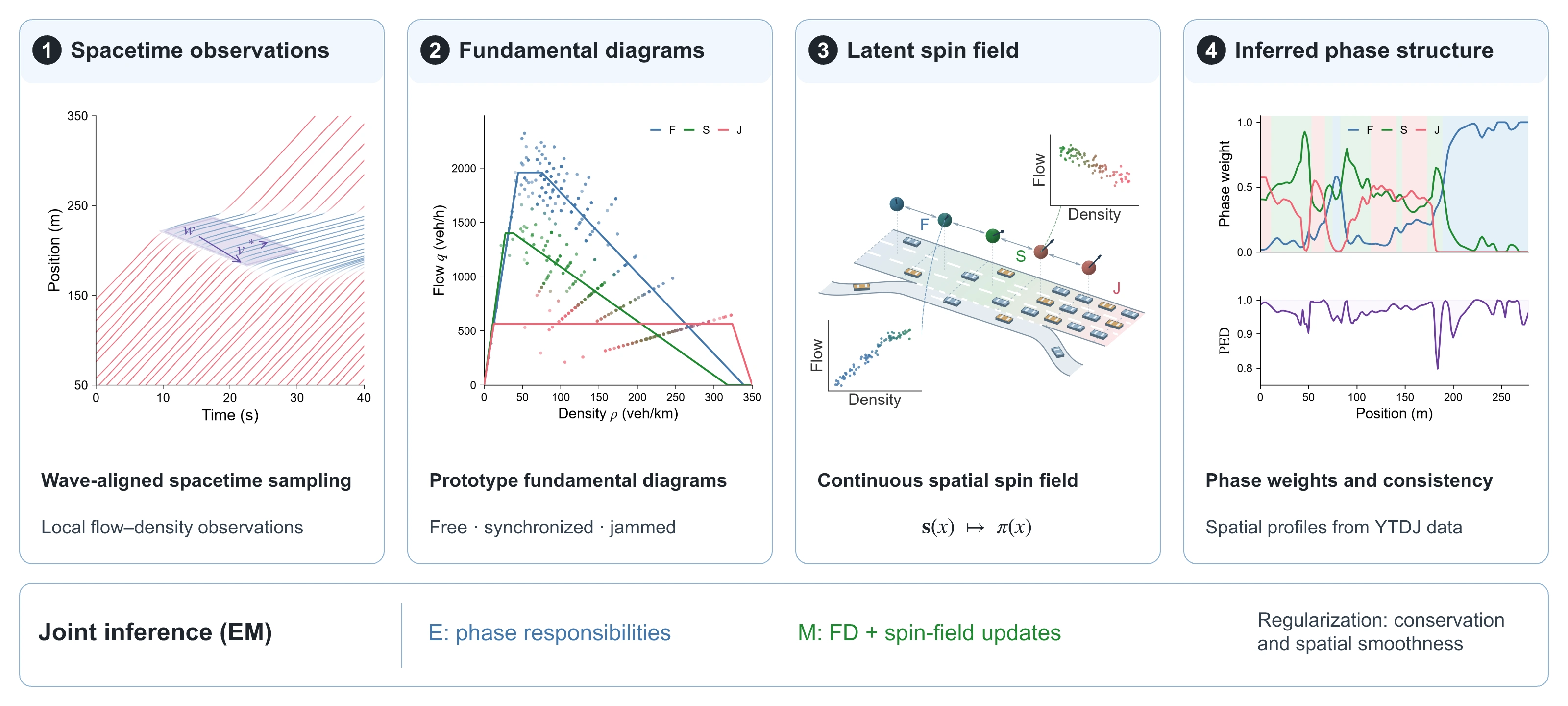
Wave-aligned spacetime sampling, prototype fundamental diagrams, and an illustrative continuous spatial spin field. Phase weights use retained YTDJ outputs; the PED diagnostic is independently recomputed.

How can vehicle trajectories reveal the structure of a traffic transition? With SpinFlow, I draw on Kerner’s three-phase theory and statistical physics to study how free flow, synchronized flow, and wide moving jams coexist and compete across space. A continuous latent spin field and a competitive-equilibrium mapping encode their local mixture. Physics-regularized expectation–maximization jointly infers the field and calibrates fundamental-diagram prototypes from wave-aligned trajectory samples, with soft conservation and smoothness penalties. The Phase Equilibrium Degree measures consistency between inferred and observation-derived mixtures. Across four real-world datasets, flow reconstruction achieves R² values up to 0.940, while disabling the competition penalty increases flow-reconstruction RMSE by 5.7–24.3%. Detected transitions in bottleneck cases align with documented lane-drop and on-ramp features. What interests me is making phase coexistence and its breakdown inferable; using that structure to guide effective interventions remains a further control question.
IEEE ITSC 2026 · Oral presentation

FLAT: Smoothing the Rugged Landscape for Learnable, Sample-Efficient Traffic Calibration

Haopeng Deng, Shuo He†, Dayuan Wang

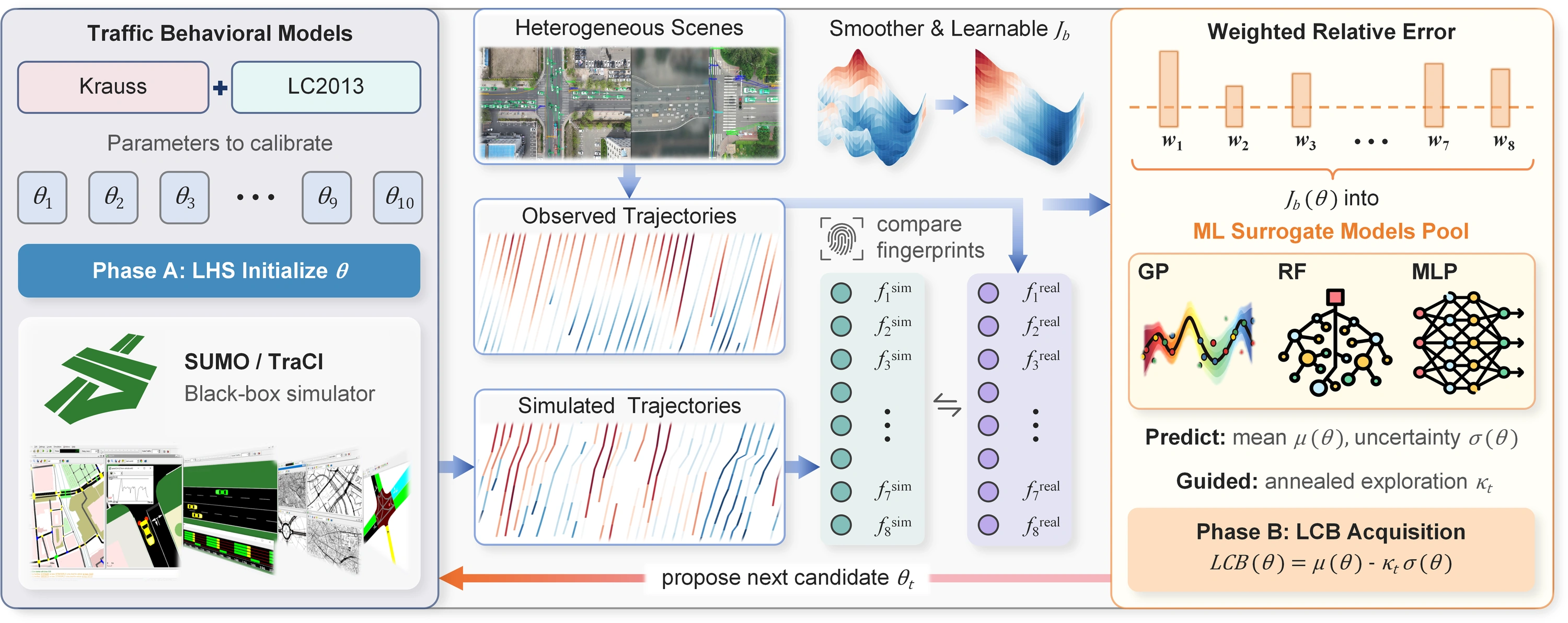
An eight-component behavioral fingerprint reshapes the objective; sequential surrogate-guided acquisition allocates the remaining simulation budget.

An expensive simulator makes every evaluation count, but a surrogate can only guide the search if it can learn the objective. I developed FLAT around this upstream choice: how should simulated and observed traffic be compared? An eight-component behavioral fingerprint summarizes speed, acceleration, and stopping behavior, producing a smoother calibration landscape. A surrogate then allocates the remaining runs through uncertainty-aware sequential sampling. Across six traffic scenes with a budget of 100 simulations each, FLAT-GP achieved the lowest average behavioral error. The revealing comparison was the ablation: optimizing a speed-series objective instead increased final behavioral error by 81% on average, while switching among GP, random-forest, and neural-network surrogates changed the global mean by at most 4.2%. These results make objective design a practical part of sample-efficient learning, alongside model choice and search strategy.

Submitted to IEEE IV 2027

Sparse Stochastic Optimal Control under Control-Dependent Diffusion and Time-Varying Dynamics

Yong Wang, Lingyue Li, Haopeng Deng, Zhu Luo†

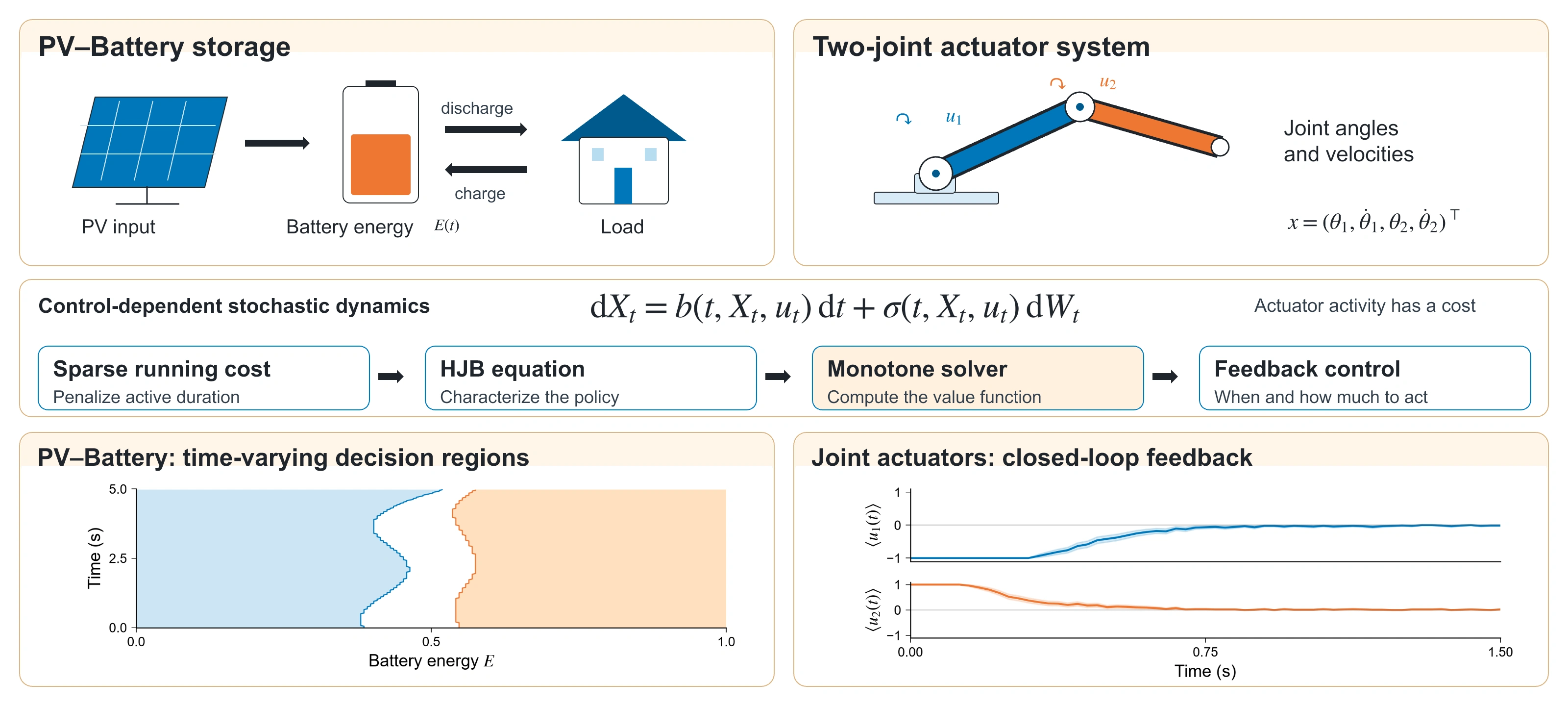
PV and joint-actuator model instances connect to numerical feedback. The lower panels are independent reduced-model numerical illustrations, with ensemble-mean actuator inputs and uncertainty bands.

When should a controller act—and when is it better to remain idle? In photovoltaic–battery storage, this means deciding when to charge or discharge; in a robotic arm, when a joint actuator can stay off. Sparse optimal control balances system performance against actuator usage, but the problem becomes harder when dynamics vary over time and control itself changes the intensity of random disturbances. The paper develops a relaxed-viscosity framework for the resulting Hamilton–Jacobi–Bellman equations and identifies when a scaled ℓ₁ formulation can recover an ℓ₀-optimal sparse policy. My contribution was implementing monotone semi–Lagrangian schemes and evaluating feedback policies in photovoltaic–battery and simplified two-joint systems. A dense-control stress test illustrates why agreement between ℓ₀ and scaled ℓ₁ policies on a saturated control grid need not extend to continuous inputs: diffusion–curvature coupling can change the preferred action.

Journal of Dynamical and Control Systems · 2026